Showing posts with label art. Show all posts

9/24/2014

To consider ancient traditions

17


While I expected to see many horticultural wonders during my visit to
what took me by complete surprise was a photographic exhibition on display
in the main entrance lobby.  The images were so compelling I used a great portion
of my garden-viewing time to read the entire story
behind each powerful photograph.


With kind permission from the desk staff, I used my phone camera as best I could
to make record of several I thought were particularly potent in their imagery & description;
those that were especially moving and/or important to me.
In light of recent Peace Day 2014 this seemed like an appropriate time to share them.

* PLEASE NOTE*
The original photographs have been slightly cropped to fit
the format of this blog post.  Reflections on framing glass couldn't be avoided
nor some odd angle and color distortions.
The descriptions were copied verbatim from the exhibit walls. 
Photographer's names are clickable to their websites.
Visit them.  They are all amazing.

:::


no strangers  poses a fundamental question: What does it mean
to be human and alive?  When the people of the world answer this question, they do so
in 7,000 unique voices.  Tragically, half of these may be silenced within a generation or two.
At risk is our human legacy, a vast achieve of knowledge and expertise.
Rediscovering a new appreciation for the diversity of culture is a
crucial challenge that should be faced.


            LHASA, TIBET
            A young Tibetan woman poses next to a Chinese fighter jet on display in front of the
            Portola Palace, the ancient home of the Dalai Lamas, the spiritual rulers of Tibet.  Such
            symbolic gestures of intimidation are encountered throughout Lhasa, which has become
            largely an outpost of the Chinese government and a symbol of their conquest of the 
            Tibetan nation.


            © Randy Olson

            OFU ISLAND, SAMOA, 2000
            The training of the Polynesian way finder, or navigator, begins in infancy as he is placed
            in tidal pools for hours at a time so he might feel and absorb the rhythms of the sea.  If,
            on his first deep ocean voyage, he becomes sick from the swells, his teacher will tie him
            to a rope and pull him behind the canoe until the nausea passes.  It was by such devotion
            and rigor that the Polynesian ancestors settled the Pacific.


            KENYA, 2006
            A Swahili woman from Kenya decorates her hands and feet with designs made from henna,
            a dye derived from a powdered leaf mixed with water and the juice of unripe lemons.  The
            designs are drawn with a fine twig; five to six applications are required to ensure that the
            henna doesn't fade too soon, a process that takes up to 12 hours.  In modern times, a black
            synthetic dye is used to enhance the elaborate designs.  A Swahili woman who appears in
            public must remain concealed in black veils and long robes.  Her hands and feet are the only
            parts of her body that may be seen.


            © Brent Stirton

            TIMBUKTU, MALI, 2009
            In 1914, when the French took control of Timbuktu, they confiscated the ancient manuscripts,
            threatened the scholars with jail and taught the children that their ancestors were not Arab
            or Berber, Tamashek or Tuareg, but Gaul.  The library pictured here is one of the oldest in the
            world.  It is filled with ancient manuscripts that have survived throughout the centuries.


            © Wade Davis

            ARNHEM LAND, NORTHERN TERRITORY, AUSTRALIA, 2008
            For over 55,000 years, the Aboriginal peoples of Australia thrived as hunters and gatherers,
            and guardians of their world.  In all that time the desire to improve upon the natural world had
            never touched them.  They accepted life as it was, a cosmological whole, the unchanging
            creation of the first dawn, when earth and sky separated and the original Ancestor, the
            Rainbow Serpent, brought into being all the primordial ancestors who through their thoughts,
            dreams and journeys sang the world into existence.  This woman stands in a sacred site of
            the Rainbow Serpent.


            © Aaron Huey

            OGLALA, SOUTH DAKOTA, 2011
            Stanley Good Voice Elk is a Heyoka (clown dancer) and a dreamer of the Thunder People.
            His Heyoka name is Wakinyan Hoksila (Wakeeya Hokshila) which means Thunder Boy, or
            or Iktomni Hoksila, Spider Boy.  He burns sage, prays and prepares for a coming kettle
            dance to thank the thunder beings (thunderstorms) as they leave for the summer.


            © Steve McCurry

            HENAN PROVINCE, CHINA, 2004
            Young monks train at the Shaolin Monastery in Henan Province, China.  The physical
            strength and dexterity displayed by the monks is remarkable, as is their serenity.  At its
            core Buddhism is simply a wisdom philosophy, a set of contemplative practices, a spiritual
            path informed by 2,500 years of empirical observation and deduction that, if followed, offers
            the certain promise of a transformation of the human heart.


            © David Hiser

            SARAWAK, MALAYSIA, 2012
            A Penan family from the Ubong River in Sarawak with a feast of wild foods - sago, wild
            boar, fruits and seeds - all gathered or hunted in the forest.  A Canadian or American grows
            up believing that poverty for some is a regrettable but inevitable feature of life.  The Penan
            live by the adage that a poor man shames us all.  The greatest transgression in their culture
            is "sihun," a concept that essentially means a failure to share.


: : :


Traditional societies are not failed attempts to be modern, let alone
failed attempts to be like us.  Every culture is a unique expression of the
human imagination and heart.
When asked what it means to be human and alive, the peoples of the world
respond in 7,000 different voices, 7,000 languages that together
express the full wisdom and knowledge of our species,
insights that no doubt will prove invaluable to future generations,
even as we continue this never ending journey.

~ Introduction, copied from the entrance wall ~


2/26/2014

The best advice

11


Gareth Bate with his  Jewel Net of Indra  installation.  Gareth is Festival Curator of the World of Threads Festival and
Exhibition Curator of Memento mori.   Photo: Saglara Kitchikova


Gareth Bate has some fabulous things to say.
He outlines some mighty fine advice for artists
including how to work with curators ...
how artists are chosen,
how artists should handle rejection ...
a treasure trove of useful information with an interesting point of view.
I think some who stop by here may enjoy reading his take on things
as much as I did ...


At the very end of the interview there is this gem:

What's the best advice you can give to artists?
The best advice I've ever heard for artists came from Art Dealer and Blogger, 
Edward Winkleman:

"Make work that is impossible to ignore."


6/07/2013

Uncommon threads

23


"When you start to think of the arts as not this
thing that is going to get you somewhere in
terms of becoming an artist or becoming
famous or whatever it is that people do, but
rather a way of making being in the world not
just bearable, but fascinating, then it starts to
get interesting again."


These eyelashes sent me on a wild train of thought 
(aside from the little girl in me who wanted to play dress-up & would beg
to try these on just once) ...
I asked myself,
what if all of us who make things
were to change our perceptions about
common
materials ... the tried & true materials we use over and over?
What might happen?


:::


Captions under each photo are clickable for the original websites


2/28/2013

2/05/2012

I went to Google & ended up at the Met...

18


I'd seen this bead posted somewhere, thought I'd find out a little more about it...
it was the date that fascinated me,
created somewhere around 500-600 A.D.
So, what else does one do?  I Googled it...

Culture: Frankish ~  Medium: Glass ~ Dimensions: 1  9/16 x 3/4 in.

and there it was, at the Metropolitan Museum of Art, in New York City.
Now, it's been a long time since I visited there in person and I don't know if  I've ever been to their website,
so what the heck, I   made the big mistake   decided to have a little wander around
and proceeded to type the word BEADED into the search box...

oh heaven help me.

Wait till you see some of the incredible beaded objects I discovered.

  But before I continue on, I want you to know that it's perfectly alright with the Met to share their images like this.  In light of recent copyright discussions here (ahem), and elsewhere amongst friends, 
I made a special point to check this on the Met's 'Terms and Conditions' page.
Clickable links are provided with every image so you can go directly to the Met's collection (and their images enlarge to full screen size - plus a zoom thingey - wow).

We're good to go, and that's really good 
because now I'm gonna show you a few of their amazing pieces of bead antiquity...


Date: ca. 680-670 B.C. ~ Geography: Egypt, Upper Egypt; Thebes ~ Medium: Blue faience beads

Constructed of tubular faience beads strung together in a net pattern, this shroud was sewn onto the outer wrappings of Tabakenkhonsu's mummy.  Additional beads in various colors have been worked into the garment at several points: a beaded broad collar has been added to the top, where the garment came over the mummy's neck;  over her breast was a winged scarab to protect the heart; and on the abdomen are four "canopic" genii who guarded the viscera.

A very interesting description of "faience" - the oldest artificial substance,
made a millennium before glass was invented -
can be found over here...


Date: mid-19th century ~ Geography: Canada, Quebec ~ Culture: Huron ~ Medium: Silk, wool, glass, moosehair ~ Dimensions: H. 2 1/2 x W. 9 in.


Date: ca. 2030-1802 B.C. ~ Geography: Egypt, Upper Egypt; Thebes ~ Medium: Wood, mud, linen string, paint

The so-called paddle doll consists of a flat piece of wood depicting the torso, rudimentary arms and neck of a woman, with a thick shock of "hair" made of beads strung on linen thread.  The body is often painted with jewelry, textile patterns and/or tattoos.  Contrary to their modern name, these "dolls" were not toys... It has been suggested that paddle dolls were an accoutrement of troops of singers and dancers who performed at religious ceremonies associated with the goddess of Hathor.

2,000 years B.C....how can this still exist???
I am in awe.


Date: mid-20th century ~ Culture: African (Dinka peoples) ~ Medium: glass beads, animal skins, wood, cowrie shells

The waist as a zone of decorative focus is not exclusive to women.  The Dinka people of the Sudan are virtually naked, save for their jewelry - necklaces, armlets, bracelets, anklets, and belts - and their beaded vests and corsets.  As each of these items is an explicit indication of age and status, their corsets are of varying scale.  The most heroic, as in this example, extend from the small of the back to a point above the shoulders.


Date: 20th century ~ Culture: African (Dinka peoples) ~ Medium: fiber, glass beads, cowrie shell


Date: 1818-1830 ~ Culture: Mexican ~ Medium: glass, silk ~ Dimensions: 4 3/8 x 1 1/2 in.

Beside the intricate beauty of the hand work, there is an interesting story behind this piece...
as there so often is.  Here is part:

The unusual shape of this early miniature reticule suggests that it served a decorative, rather than functional purpose.  Probably hand knitted, it is part of the Mexican beadwork collection of over 600 pieces assembled by Elizabeth Morrow (1873-1955), mother of writer Anne Morrow Lindbergh, the wife of renowned aviator Charles Lindbergh.  Morrow collected the objects between 1927 and 1930, when her husband, Dwight Morrow, Sr., served as U.S. ambassador to Mexico...

Date: 19th-20th century ~ Geography: Nigeria ~ Culture: Yoruba peoples ~ Medium: wood, glass beads, cloth, leather, fur, metal, pigment 


Date: 12th-14th century ~ Geography: Peru ~ Culture: Chimu ~ Medium: Spondylus shell and black stone beads, cotton ~ Dimensions: H. 17 1/2 x W. 15 in.


Date: 19th century ~ Culture: English ~ Medium: bone, metal and beads

There were no dimensions for this one on the Met's website...I wonder about its size.
And would this be a fancy bobbin for lacemaking?
It is divine, whatever the intended use.

: : :

Just a couple more to show you - I feel like a glutton too long at the bead table!
But these next two exquisite textile pieces you must see...

a 1920's bead embroidered silk velvet dress...

Designer: Jean Patou ~ Date: ca. 1924 ~ Culture: France ~ Medium: silk, metallic thread, metal beads


...and this sample embroidery cloth of the same era, attributed to Sarah Lipska, a Polish designer.

Date: 1920-29 ~ Culture: French ~ Medium: silk, metal ~ Dimensions: 34 1/2 in.

This object is from a collection of sample embroideries, which was originally owned by Morris de Camp Crawford, editor of Women's Wear Daily, who collected objects which told the story of fashion and fabric history...Lipska is an enigmatic figure, who is known to have worked with Leon Bakst as a set and costume designer for the Ballets Russes, and later in the 1920s as a fashion designer in Paris at 4 rue Belloni, and finally as a sculptor.  Extant examples of her work are rare...

Please treat yourself & view this over at the Met, 
click to enlarge - then zoom in to see her beautiful beaded stitches...

whatever you do, stay away from the search box.
You have been warned.


2/12/2011

12/10/2010

12/04/2010

First Friday and some other firsts...

12


Every month in nearby Old Town Anacortes, they have what's called 'First Friday Art Walk.'
Galleries, shops & eateries stay open late and the main drag buzzes with activity.
Have you ever been to one of these?  Oh so much FUN.
But there's something extra special about the First Friday in December.
The holiday season seems to infuse it with such a festive spirit
and a festive spirit was just what I was after.  


A clear, cold night perfect for those with warm winter coats, like dawg,
who came along for a night on the town.
Although a rural woofer, she'll never pass up an opportunity to prowl for pats.


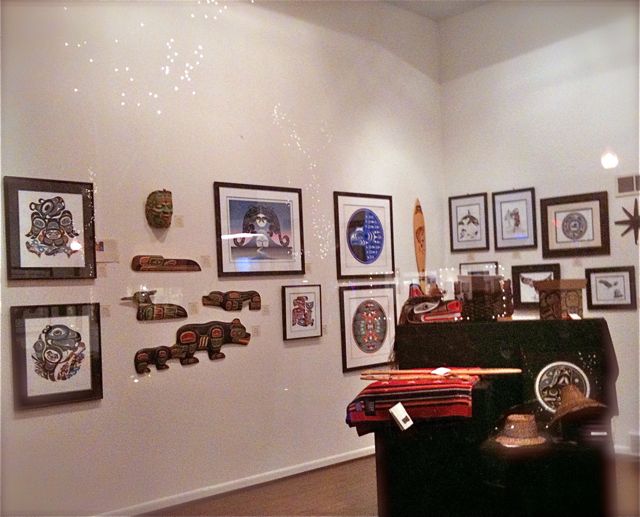
The Samish Gallery of Native Arts was filled with stardust!
Ok, window reflections from the street trees but that would make for a good story, wouldn't it?


Glass snowflakes...


woolies...


and little antique shops with scents of mulled wine & hot apple cider
wafting from the doorways, not to mention the baked goods heaped on trays.
Ok, we won't.  But that led to this...


THE BEST restaurant in town.
For starters, a to-die-for Thai tomato bisque soup followed by
seared scallops in lime butter, sauteed organic kale with garlic
sided with a scrummy potato croquette,
all washed down with a local red.
Yup, the feelin' was quite festive indeed.

By morning,
the sun brought these...


long, glorious shadows after days & days of gray-upon-gray.
The first sun of December!


Upstairs on the worktable, there was a little weather happening.
Some rain was falling...
T's soft rain, all the way from Australia where they are having summer
and where I like to imagine their stories are being stitched into storycloths, too.

Sending heartfelt wishes of good cheer and festive spirits to all!

Note: all night photos were taken with the trusty phone (aka Batphone)