Showing posts with label repurposed textiles. Show all posts

1/27/2018

Inspire :: By Walid

15

Mr. Walid al Damirji is a clothing designer based in London's Mayfair district.
He is unusual in that enterprise because his upcycling brand, By Walid, doesn't lean on
a traditional need for massive press coverage or big, glitzy fashion shows ...
Walid's preference is to remain a small, artisanal, cottage industry,
creating the most remarkable (to my eyes, at least) one-of-a-kind garments.

He may not be able to maintain this more quiet approach for long.
His garments are quite incredible and since his launch in 2011,
word has been spreading like ripples across a still pond.

Every piece, made by hand.

~ 19th century Ottoman splendor for the new Murat jacket, Autumn/Winter 2018 ~

"It's a collection of clothing made from repurposed heritage and
antique fabrics, some of which date as far back as the 18th century. And if this
recycling-upcycling concept is unusual, the way it's applied is even more so.
Every fabric used in By Walid's collection is a mixture of many different
repurposed textiles - from 19th-century French damask to embroidered silk kimonos to
Victorian table linen - cut and sewn together by hand on an organic cotton base
with an embroidery technique reminiscent of the traditional Japanese art of  boro.
Each fabric is then hand-dyed before being turned into the final garments.
They are then hand-finished, resulting in pieces that, in every detail,
are one-of-a-kind clothes."
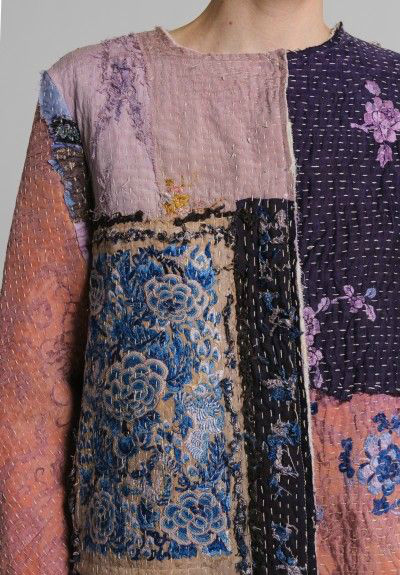


Torn - often shredded - vintage textiles
given a new life ...


The shapes are clean and understated, but oh my, the fabrics can be
sumptuous and often include lace, crochet and beading ...


: : :

........ links to explore .......
By Walid on Instagram
Short little YouTube : Walid on Shape, Texture and Fabrics
About : Bio from his website


: : :

To begin at the beginning of this album of makers,
please click this tag : Inspire-album


3/09/2015

Madder madness

21

or - what  NOT  to do if you desire true red.


Dye day in the middle of winter ... what else could we expect?
We were not precise.  We did not follow protocol.
Fortune might favor prepared minds but when it came to trying this new dye source
our minds were  not  [prepared, that is] ... which actually seemed ok at the time.
Our main objective was just to play,
see what happened if we flew by the seat of our pants ...


Spelled out, to see what happened
if ... we didn't carefully weigh the correct amount of madder powder
if ... we didn't pre-mordant our cloth
if ... we didn't check the water pH
if ... we didn't use a thermometer to check dye bath temperatures while cooking.
Although the bath never did come to a boil [big no-no],
with a list like the above it's a wonder we achieved any pleasing color at all.

~ frontispiece silk blouse #1 ~

It was January
and like a pair of hooligans with only a couple of hours to spare before the pub closes,
we went about things a bit wildly, bypassing [most of] the well-published rules ...
we prepped our dye pot mainly on a couple whims, a few educated guesses
and several generous splashes of laughter.

Obviously, this was not the recipe to follow
if the color one is after is anything akin to true royal  RED.
Dyeing with madder has a rich and ancient history and although we were intrigued,
the desire to 'wing it' won out in the end.
We were short on time and long on laissez faire.


Maiwa provided useful background info over on their site:

Madder – Rubia tinctorium, Rubia cordifolia, and Morinda citrifolia is one of the oldest dyestuffs. It is frequently used to produce turkey reds, mulberry, orange-red, terra cotta, and in combination with other dyes and dyeing procedures can yield crimson, purple, rust, browns, and near black. The primary dye component is alizarin, which is found in the roots of several plants and trees. Madder is cultivated and grows wild throughout India, South East Asia, Turkey, Europe, South China, parts of Africa, Australia and Japan. 
Madder is a complex dyestuff containing over 20 individual chemical substances. 

Alizarin is the most important because it gives the famous warm Turkey red colour. But also present in this wonderful plant is munjistin, purpurin, and a multitude of yellows and browns. Madder is dyed at 
35-100% wof [weight of fabric] for a medium depth of shade.

Our first lesson of note is contained in that last line about weight of fabric:
next time, for deeper shades, we definitely need to add more madder.
[L. brought back quite a hefty bag of powder from her recent travels
so we have plenty for another go ...]

~ silk blouse #2, no iron, bundled around copper ~

So although in principle I am not adverse to toasty apricot, salmon-pink,
or something resembling a mango chutney,
I'd like to accomplish a deep luscious red

someday ...


~ silk blouse #3, iron bits inside bundle, folded like a sandwich with native madrone ~


~ concentrated color in dry-down marks ~

After-the-fact research on this dye stuff has been fascinating, while some of the
best examples of color comparison I found online were those done on wool yarn -
which, as it happens, depends heavily on the use of mordants.

~ photo credit: Brush Creek Wool Works ~

I chanced upon this comprehensive blog post,  'Madder, in Many Ways'
over at  Sea Green and Sapphire ...
some excellent photos there showing the multitude of hues & tones that can be achieved.

Since I'm most interested in dyeing silks, my road to hoe may differ somewhat
but I won't know how much until further experimentation.


The historically acclaimed light-fast and wash-fast properties of this plant dye
certainly hold much appeal.

~ Rubia tinctorum, courtesy of Wikipedia ~

Next time we'll put ourselves in a more "scientific" frame of mind
before setting out ...
and in the meantime, if anyone stopping by here has a suggestion or two to offer,
my most appreciative ears are wide open.


2/23/2015

Pleased to announce ... India Flint returns to Lopez Island

11

Workshop plans have been afoot for some time now
with a pre-assembled cast of characters awaiting the sewing tables and cauldrons ...
but as life does, it got in the way for two
and now there are spaces in this September's gathering,
 perhaps for you?

~  TWO SPACES AVAILABLE  ~

'the wayfinder's wander jacket'
with India Flint
September 23 ~ 25, 2015
Lopez Island, WA, USA

~ Patsy's Garden Shed Studio, Lopez Island & sweet Isla, having a wander ~

**** UPDATE 2/24 **** CLASS FULL, thank you to all who enquired!

Enjoy three days with India on lovely Lopez Island, sharing stories and stitching
a beautiful bundle-dyed hand-sewn multi-pocketed and hooded jacket
using fabrics gleaned from pre-used garments
and embellished with silk and wool scraps.
The magic of the Salish Sea, the use of scrap metals
along with a wide array of bio-regional dye sources
~ windfallen leaves, weeds, & bounty from local gardens ~
will influence the dye outcomes.

Nourishing gluten-free vegetarian lunches will be provided each day
including delicious soups made by India ...
who is a deft & creative hand around a kitchen cauldron as well ! 

For all the particulars, or to answer any questions,
please send a private message via this email link:
Christi's  EMAIL 
[please, serious enquiries only]

Note:  This is a  rural   location involving multiple
[sometimes complicated]
means of transport.
~  think slow  ~

❖ to read about India's workshop on Lopez in 2013 click here  ❖
website  ❖  indiaflint.com


12/04/2014

Natural progression ... of sorts

16


We've had a long stretch of uninterrupted bone-chilling cold.
The second heat lamp in the pump house has been kept on
[ not good to risk frozen pipes with our primary water source ]
but nothing stops the back pond from freezing over;
much to the chagrin, I imagine, of the small band of buffleheads
that paddled around in sweet abandon for a week prior.
Wonder where they've gone off to now?


The ice crystals criss-cross in a beautifully random manner.

Knitting seems to be primarily a winter habit for me ... dunno why.  
It's a soothing activity in the long hours of darkness.  I'm not much good at it
[ close inspection would reveal many wabi-sabi mistakes ] but I enjoy my time with it nonetheless.
The season has arrived, for this bit of lacy indigo recently came off the needles


and this green scarf-lette jumped on next.
Fell in love with this nubby yarn ... a blend of 70% silk 30% cotton
Very light ... shall come in handy on my summer travels when an 
evening breeze next to some bonny shore
has me reaching for an extra pinch of warmth.


Had to order an especially long pair of circular needles for this one
as my longest edge will be 52 inches.
Whoever invented the circulars should be awarded a Nobel prize,
don't you think?

So, late yesterday a pleasant walk with the dogs took us round the far back side
of the pond where we hadn't ventured in quite some time.  There are two
"wrapped trees" back there and it's been my practice to check up on them occasionally,
see how the cloth is faring ....

oh my
what a surprise
to discover the downed willow was missing its wrap!
And not only was the the cloth gone, but
the tree had been severely gouged by wandering deer
who'd used it for a scratching post


If you've been visiting here for awhile you may remember its earlier days ...
Here's the photo I posted four years ago showing the fresh wrap
[ notice the willow hadn't grown any lateral shoots yet ]

~ newly wrapped, September, 2010 ~

This piece of old cutwork cotton was from a tablecloth
I found at the thrift store.  So pristine, so   WHITE    back then ...

Then, just two years ago this is how it looked, greening up nicely from the lichen
and lord knows what else.

~ January, 2012 ~


~ May, 2013 ~

By spring of last year, the top portion had slipped some although the binding cloths
were still holding fast.  I contemplated removing it at this point but my curiosity 
won out and I decided to wait some more.
At that time, I was the last holdout amongst the members who'd
joined 'wrapt, tied and marked by nature' 
[ the blog has since been removed by its owner so I'm unable to provide the link to all the stories ]
... an interesting group project which involved about 8 of us from 
different areas of the world who wrapped cloth around parts of trees, 
leaving them for a period of  six months or more
in order to see what marks Mother Nature might provide.
We then recorded our results on the group blog, exchanged ideas, encouragement, etc.,
great fun overall.
Other climates produced very different results and
since I saw zero change after six months,
I decided to just keep going.

I wish I'd copied my original posts from the group blog
where I described in great detail the varieties of trees and the types of 
cloth I used for each.  Alas, all is not lost for I still have all the photographs spanning
the years, if not my written words.


But back to the fallen willow ....


After rooting around in the leafy detritus piled underneath,
lo and behold I found a scrap - ONE scrap of the original tablecloth !
I had visions of local deer galavanting about the woods with cutwork
dangling from their antlers -- what a sight that would be --
for what other conclusion was there than they'd scratched all
the rest away?


It's barely holding together.  Quite a fragile delicate thing now.
Once it's dried I'll carefully lay it out flat, assess what's really become of it
and make a decision about what's to follow.

First it was found,
then it was dyed ...
I may already know what comes next.


8/13/2014

Getting the hang of it

28


Someday I hope to unwrap a bundled article of clothing
and have it 
not
look like an old paint rag.
Assembling the right combination of ingredients isn't the key ...
choosing the right fabric doesn't seem to be the key either ...
nor is how I roll it up, tie the string,
the cooking time or whether the vegetation was frozen or fresh
or how long I've let time be my friend afterwards ...
and shoot, I may have forgotten to pre-mordant.
None of these is  the  key
because
ALL
of
them
are.


So
that's the main thing I'm learning about this natural dyeing process,
the reason why it's so critical to keep practicing, work steadily, experiment,
build a knowledge base one step on top of the other.

Luck will only get ya so far.

Then
there's that no-small-matter of
 intuition ... 
often just a quiet fluttering off to the side,
a barely noticeable nudge
 towards a choice I wasn't going to make.
Am I listening hard enough?


I will concede that
some paint rags are prettier than others
but
I've got miles to go before
purple blobs are gonna be skillfully arranged into a
worthy item of clothing ...
at least
that's how it feels today.
But I am a bit cranky.

Maybe I should just blame it on the Super Moon ...

I feel a bit like that button !

Tis one good thing tho:
thrift store stuff is cheap
and fairly plentiful.

Oh.
TWO good things ...

nothing in the world like having the fine company of Her Fluffiness 
when I'm a tad grumpy ... 


12/11/2013

10/14/2013

Tossing in the whole shirt

49


After the workshop with India finished, my feet did not touch the ground
for about two weeks.
The first dye pot to hit the little hot plate on the porch 
became a native "soup" ... still riding high on inspiration,
I took a gamble with a weedy willow by the back pond
and after a vigorous haircut ~ leaves, branches, twigs, bark and all ~
simmered up some [surprising] tannin-rich color.

Then I decided to dye an entire shirt ...

yes, me ~ the one who only dyes small scraps of things.

- spent innards from the dye bundle & the wrapping stone -

During a jaunt to the village earlier in the week there had been a gentle query:
had I ever used  those leaves  [pointing to a purple-leaved maple] for dyeing? 
to which I replied, no.
When it was heartily suggested that I give them a go,
I knew that not heeding this very wise voice of experience
would be foolish.

A carpet of windfall was conveniently at hand on my next visit.


- saving string -

It was a challenge wrapping an entire piece of clothing.  I hadn't done it before
and found myself imagining where the stronger marks would appear; 
should leaves be face-up or down; would I
wrap around a piece of wood so as to float half submerged, or a stone,
to sink to the bottom.

This wrapping string

Red Silver Maiden Grass ~ Miscanthus sinensis 'Rotsilber'

had quite a lot in common with the plumes of the maiden grass
next to the house, I thought ...


which relates to the outcome in a way, too.

Everything is so connected in this arena
of the natural world.

Echoes everywhere.


I am so comfortable here.


Now, if I only had a tad bit of tailoring ability I'd be able to
deconstruct this silky number and turn it into something that fits.
[must keep that in mind the next time I decide to save a whole shirt from the scrapper.]

:::


When next I post, it will be my  200th  ... how is that possible?
Perhaps we should celebrate, mark the event with a small *giveaway* ...
a name-in-the-hat thing for those of you who visit.

I'm so grateful.

Oh yes, this could be fun ... I'll see what I can come up with.  
Maybe dawg will have a paw handy 
to pick the name.


5/26/2013

5/17/2013

2/12/2013

2/09/2013

1/30/2013

1/25/2013

1/12/2013

9/14/2012

Navigation: bundle #4

18


Looks like a dirty old rag.
If you walked by it on the street, you wouldn't stop to pick it up...


if you saw it laying on a park bench,
you probably wouldn't want to sit next to it....
even if you knew there were red rose petals stuffed inside
or that it was a delicately edged vintage napkin hiding under all that *grime*.

Strange things can happen during a two-day eucalyptus and iron soak...


Heavy linen seems to love being pre-mordanted with ash water.
Oh, what a learning curve all this trial & error has been....is....
every cloth becomes another building block towards understanding.  There are moments
when it all feels uphill and quite arduous,
and
very labor intensive.


Thank goodness for important reminders.

Just

keep

going.


: : :