Showing posts with label natural dyeing. Show all posts

8/06/2017

Protection

9


Sometimes it's advantageous to set a project aside when it reaches an impasse.
I can't remember exactly why I stopped working on this series in the summer of 2013,
but I remember exactly why I started ....
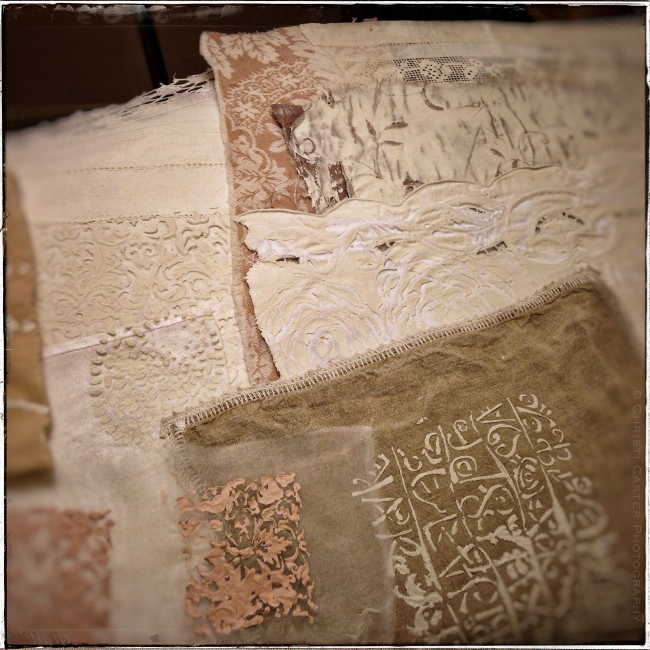
beadwork on naturally dyed cloth
that hopefully could symbolize thoughts I was having about
how we humans guard ourselves.
Not only the different ways we protect ourselves from each other, 
how we wear masks so that our real selves can't be seen or fully known,
but also how we guard ourselves out in the world.
Somewhere there's a list - a long list of words I wrote to itemize all the ways we might do this.
Need to dig that out now
because I think the time is ripe for carrying on with this.


4/23/2017

Minding my maps

8

Merriam-Webster defines  map :
1 a:  a representation usually on a flat surface of the whole or a part of an area
b:  a representation of the celestial sphere or a part of it

2 :  something that represents with a clarity suggestive of a map
~ the Freudian 'map' of the mind -- Harold Bloom

so I got to thinking ....
could photographs act just as easily as maps of a  life?


If I mapped myself, what might that look like?
And if I focused on, say, my creative life, would it be telling?
Could I show the route from back there 
to here?

So I gave it a try & here's where it led me ...


To the convergence of paper and books


to beads on cloth with an uncertain latitude


towards an elusive north star


with an ever present guiding light


and a dear navigator who teaches all the compass points.


Just a small smattering of map pages - old directions & new ...
so yes,  I can see how I got here


but perhaps the more important question is
just where am I going?

[ this is where a hushed voice offers, "Only the cartographer knows for sure..." ]


11/16/2015

After the storm

21

We recently had a whopper of a gale.  A long night,
then an even longer dark day of sideways rain and rattle-the-rafters wind.
The lull that followed meant only one thing - time for beachcombing - so four-paws and I
headed out to see what we could find.  I wasn't entirely sure there'd even be a shore left.
Predictions had been ominous but living as we do on a tiny rock out in the Pacific Ocean
 we know variables can be extreme island to island.  I needed to see firsthand how our
favorite spot had fared.

Thankfully, it was not so bad really.
Bull kelp was in abundance, having woven itself down the beach in dramatic ropes.  A few
boulders that support the edge of the two lane road had been displaced and
one or two megalithic tree stumps (from Canada perhaps?) had been dredged up & tossed ashore
like toothpicks.

The donations from the sea were plentiful.


I left this red one in place.  Figured a heart rock was better doing its good business under
a big sky, near a Big Puddle, than home with me in my pocket or on my windowsill.

This particular beach is in somewhat protected waters, with San Juan Island directly to 
the east & San Juan Channel in between, so it isn't like beaches that 
face the open ocean where lots of human trash prevails
(I'll pay you five dollars if you can even find a piece of sea glass on this stretch),
but it does hold a motherlode of natural detritus ...
driftwood
stones
shells
some feathers
and lots of seaweed ... especially during storm season.


And there was our "garbage" to collect and treasure.  Hadn't seen this around
for a whole year - a reddish seaweed that makes lovely rose-colored marks when wrapped in 
cloth (especially silk) if one is game to judiciously watch temperatures in the dyepot.

Worth the whole walk, was that.
:::
Have you ever heard of the British artist, Jo Atherton?
She weaves tapestries with the flotsam from her beaches & other coasts of the world
and tells some very interesting stories ...


11/07/2015

Introducing 'Dear Flora' ...

12

To all of you who visit here
and who may also be on Facebook,
I have recently launched an artist page :


I hope you'll visit me there!
Come have a look-see, maybe take part in the conversations
or just say "Hey"...


What's in a name?
Dear Flora  is my open love letter to the world of plants & my relationship with her ...
and it isn't a name only for Facebook
but one I'll be putting with the things I make as well.

Its flight time.  I need to share this evolution that's so astoundingly
taken my heart by storm.


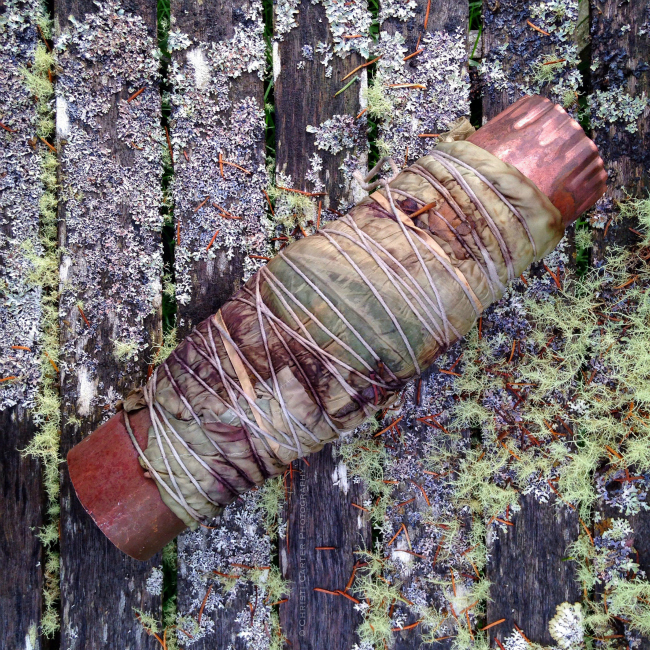
I think I've been kin to that wrapped up, tied tight, bundle above ....

and yet what I really need to do is let loose some.  Sway with those breezes
that do such fine things with silks when they're out in the open air.


Silk -  strong and soft at the same time.

:::

See you soon.


7/14/2015

Studying the ways of water ...

18


A few experiments from my last diving session with paper
These entailed using several varieties of watercolor & printmaker's paper;
frozen and fresh gleanings from the garden & hedgerow;
a steam bath, an onion bath, a mixed willow bath
and another that bordered on sage green;
alum pre-mordanting;
iron dipping & not iron dipping,
wrapping around pipes & layering between tiles.


The language of plants on cloth is certainly related to paper.  But not distantly,
like a 3rd cousin of your brother-in-law ... much closer, like siblings
who just don't live in the same state.
Water seems to me to be their shared vehicle
and I find it utterly fascinating how the exact same leaves can print
one way on cloth and another way altogether on paper.

: : :

"You don't have to be fully formed to get started on your work.  If that were true no one would ever start anything. But we live in a society were everyone wants to be a superstar and often find it difficult to be a beginner.  Think of all the great people and of their amazing journeys to reach the tops of their profession.  They were beginners who took action."

An inspiring quote by Terry Jarrard-Dimond
from her blog post,  Act On Your Ideas


4/04/2015

Alchemy in the pantry

35

It all began 423 days ago.


I gathered together these assorted fabric scraps [once all white] and without pre-mordanting,
rolled, bundled, squeezed and cajoled them into glass jars along with pieces of metal
and handfuls of vegetation.
Following the protocol within this little gem of a book,

I began a very  LONG  and interesting canning experiment ...
not only an experiment in patience [wasn't sure I could wait this long for the reveal!]
but in the science - and art - of preserving.

What would grandma say?
Go peek at what these jars looked like when I first put them on the pantry shelf
February 4, 2014 ...
over here


This is what they looked like right before I opened them two days ago.
The liquid had long since turned almost black.  They each contained iron bits 
so that made sense, but I wondered if I'd made a mistake & added too much.
Also, two of the jars had slightly rounded lid tops ...
were the contents rotting, or worse - putrefying into some gads-awful mess?

I need not have worried. And I should certainly know by now
that India speaks true words when she repeats, "Trust the process."


I flung them on the rosebushes in the hedgerow to dry.
There's often great changes between wet and dry so the short wait
to see that happen was almost worse than the entire previous year's wait.

Here they are dried and pressed.


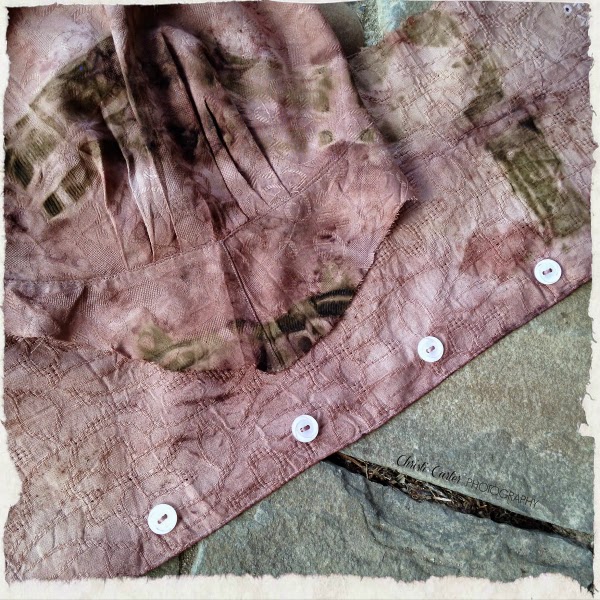
Front & back views of 60/40 cotton/silk blouse remnant,
bundled with rose leaves & metal bolts
with 1/4 c. aged copper/vinegar modifier added to the jar.
[above on far right]

What amazes me: true spring green leaf prints, the smokey black-on-black tones
from the string marks, and that the liquid from the jar smelled faintly of rose petals.


Scraps of two cotton shirts each bundled with dry purple Norway maple leaves
and metal bits - nails & screws - with additional leaves packed around the edge of the glass.
The jar was then filled with leftover - very stinky - lobster mushroom dye bath.
[jar above in middle]

What amazes me: although the jar lid was "puffed up" there was nothing growing inside ...
no bacteria, algae etc. and the smell of lobsters had almost completely disappeared,
replaced by an earthy scent; the cuff, which took color like a sponge.


I've left my favorite jar for last ... although in my earlier post I forgot about
this linen hankie entirely because I stuffed it down the side of the jar
at the last minute as there was plenty of room left
next to the ripped up linen shirt jacket.
[jar above on left]

As for my favorite - the jacket piece - iron bolts
went into the jar bottom, then the cloth was bundled
with purple-black violas, madrone bark & 4 rusty landscape pegs.
Taking a precious cue from the book, I sprinkled a teaspoon of fireplace ash
into the mix.

What amazes me: navy blues from the violas, strong distinct graphics, heavy
saturation of color.  This is a very dense linen that was not pre-mordanted and I venture
to say with a great deal of certainty that I would not have been able to
achieve this result with a one hour boil-up and a bundle opening 3 days later ...


Alchemy in the pantry.  I am smitten.

: : :

There's a wealth of jars awaiting their openings over in India's virtual pantry ...
see everyone's experiments there
Click on 'The pantry' to view the collection.

So, WHO is next?
I'm so excited for the reveals!

Have been kicking myself that I didn't experiment with whole items of clothing
for although the wait was definitely worth it, the 'time price' we pay is quite hefty
and may as well yield more of a product than a torn sleeve & a color swatch, wouldn't you say.

Ah well.  Live & learn.  All valuable, all good.

But ... I'm off soon to find some large pickle jars!


3/09/2015

Madder madness

21

or - what  NOT  to do if you desire true red.


Dye day in the middle of winter ... what else could we expect?
We were not precise.  We did not follow protocol.
Fortune might favor prepared minds but when it came to trying this new dye source
our minds were  not  [prepared, that is] ... which actually seemed ok at the time.
Our main objective was just to play,
see what happened if we flew by the seat of our pants ...


Spelled out, to see what happened
if ... we didn't carefully weigh the correct amount of madder powder
if ... we didn't pre-mordant our cloth
if ... we didn't check the water pH
if ... we didn't use a thermometer to check dye bath temperatures while cooking.
Although the bath never did come to a boil [big no-no],
with a list like the above it's a wonder we achieved any pleasing color at all.

~ frontispiece silk blouse #1 ~

It was January
and like a pair of hooligans with only a couple of hours to spare before the pub closes,
we went about things a bit wildly, bypassing [most of] the well-published rules ...
we prepped our dye pot mainly on a couple whims, a few educated guesses
and several generous splashes of laughter.

Obviously, this was not the recipe to follow
if the color one is after is anything akin to true royal  RED.
Dyeing with madder has a rich and ancient history and although we were intrigued,
the desire to 'wing it' won out in the end.
We were short on time and long on laissez faire.


Maiwa provided useful background info over on their site:

Madder – Rubia tinctorium, Rubia cordifolia, and Morinda citrifolia is one of the oldest dyestuffs. It is frequently used to produce turkey reds, mulberry, orange-red, terra cotta, and in combination with other dyes and dyeing procedures can yield crimson, purple, rust, browns, and near black. The primary dye component is alizarin, which is found in the roots of several plants and trees. Madder is cultivated and grows wild throughout India, South East Asia, Turkey, Europe, South China, parts of Africa, Australia and Japan. 
Madder is a complex dyestuff containing over 20 individual chemical substances. 

Alizarin is the most important because it gives the famous warm Turkey red colour. But also present in this wonderful plant is munjistin, purpurin, and a multitude of yellows and browns. Madder is dyed at 
35-100% wof [weight of fabric] for a medium depth of shade.

Our first lesson of note is contained in that last line about weight of fabric:
next time, for deeper shades, we definitely need to add more madder.
[L. brought back quite a hefty bag of powder from her recent travels
so we have plenty for another go ...]

~ silk blouse #2, no iron, bundled around copper ~

So although in principle I am not adverse to toasty apricot, salmon-pink,
or something resembling a mango chutney,
I'd like to accomplish a deep luscious red

someday ...


~ silk blouse #3, iron bits inside bundle, folded like a sandwich with native madrone ~


~ concentrated color in dry-down marks ~

After-the-fact research on this dye stuff has been fascinating, while some of the
best examples of color comparison I found online were those done on wool yarn -
which, as it happens, depends heavily on the use of mordants.

~ photo credit: Brush Creek Wool Works ~

I chanced upon this comprehensive blog post,  'Madder, in Many Ways'
over at  Sea Green and Sapphire ...
some excellent photos there showing the multitude of hues & tones that can be achieved.

Since I'm most interested in dyeing silks, my road to hoe may differ somewhat
but I won't know how much until further experimentation.


The historically acclaimed light-fast and wash-fast properties of this plant dye
certainly hold much appeal.

~ Rubia tinctorum, courtesy of Wikipedia ~

Next time we'll put ourselves in a more "scientific" frame of mind
before setting out ...
and in the meantime, if anyone stopping by here has a suggestion or two to offer,
my most appreciative ears are wide open.


12/04/2014

Natural progression ... of sorts

16


We've had a long stretch of uninterrupted bone-chilling cold.
The second heat lamp in the pump house has been kept on
[ not good to risk frozen pipes with our primary water source ]
but nothing stops the back pond from freezing over;
much to the chagrin, I imagine, of the small band of buffleheads
that paddled around in sweet abandon for a week prior.
Wonder where they've gone off to now?


The ice crystals criss-cross in a beautifully random manner.

Knitting seems to be primarily a winter habit for me ... dunno why.  
It's a soothing activity in the long hours of darkness.  I'm not much good at it
[ close inspection would reveal many wabi-sabi mistakes ] but I enjoy my time with it nonetheless.
The season has arrived, for this bit of lacy indigo recently came off the needles


and this green scarf-lette jumped on next.
Fell in love with this nubby yarn ... a blend of 70% silk 30% cotton
Very light ... shall come in handy on my summer travels when an 
evening breeze next to some bonny shore
has me reaching for an extra pinch of warmth.


Had to order an especially long pair of circular needles for this one
as my longest edge will be 52 inches.
Whoever invented the circulars should be awarded a Nobel prize,
don't you think?

So, late yesterday a pleasant walk with the dogs took us round the far back side
of the pond where we hadn't ventured in quite some time.  There are two
"wrapped trees" back there and it's been my practice to check up on them occasionally,
see how the cloth is faring ....

oh my
what a surprise
to discover the downed willow was missing its wrap!
And not only was the the cloth gone, but
the tree had been severely gouged by wandering deer
who'd used it for a scratching post


If you've been visiting here for awhile you may remember its earlier days ...
Here's the photo I posted four years ago showing the fresh wrap
[ notice the willow hadn't grown any lateral shoots yet ]

~ newly wrapped, September, 2010 ~

This piece of old cutwork cotton was from a tablecloth
I found at the thrift store.  So pristine, so   WHITE    back then ...

Then, just two years ago this is how it looked, greening up nicely from the lichen
and lord knows what else.

~ January, 2012 ~


~ May, 2013 ~

By spring of last year, the top portion had slipped some although the binding cloths
were still holding fast.  I contemplated removing it at this point but my curiosity 
won out and I decided to wait some more.
At that time, I was the last holdout amongst the members who'd
joined 'wrapt, tied and marked by nature' 
[ the blog has since been removed by its owner so I'm unable to provide the link to all the stories ]
... an interesting group project which involved about 8 of us from 
different areas of the world who wrapped cloth around parts of trees, 
leaving them for a period of  six months or more
in order to see what marks Mother Nature might provide.
We then recorded our results on the group blog, exchanged ideas, encouragement, etc.,
great fun overall.
Other climates produced very different results and
since I saw zero change after six months,
I decided to just keep going.

I wish I'd copied my original posts from the group blog
where I described in great detail the varieties of trees and the types of 
cloth I used for each.  Alas, all is not lost for I still have all the photographs spanning
the years, if not my written words.


But back to the fallen willow ....


After rooting around in the leafy detritus piled underneath,
lo and behold I found a scrap - ONE scrap of the original tablecloth !
I had visions of local deer galavanting about the woods with cutwork
dangling from their antlers -- what a sight that would be --
for what other conclusion was there than they'd scratched all
the rest away?


It's barely holding together.  Quite a fragile delicate thing now.
Once it's dried I'll carefully lay it out flat, assess what's really become of it
and make a decision about what's to follow.

First it was found,
then it was dyed ...
I may already know what comes next.